My Writing

Showing posts with label Food & Drink. Show all posts

24 December, 2020

An Immodest Proposal

According to the news media, Canadians are increasingly fed up with porch-bandits stealing the parcels that are a concomitant of this pandemic year. I believe I have come up with a solution to the problem.

First, collect any fruit cakes you have got hanging about your house. As we all know, Christmas cakes are often baked but seldom eaten.

Second, wrap the cake(s) in aluminum foil.

Third, place the wrapped cake(s) in any cardboard box available. Ideally, use a box with an Amazon label.

Fourth, place the box onto your porch. Leave it there for human nature to take its course. It would serve the $^@#*^^%$ right.

Image by Mokkie by way of Wikimedia Commons


26 February, 2020

In Such Good Taste

I continue to be fascinated with the online discourse recently about criticism and the role of critics. Especially as I find myself becoming much less (publically) judgmental than I used to was: at the risk of being repetitive I will mention that during my younger days I worked as a critic for newspapers and radio in a very broad variety of fields.

Including that of restaurant reviewing. It's not something I make much of, because my career didn't last very long: my doctor told me I had better stop dining out professionally if I wanted to reach the age of 40. But for a short period of time I revelled in the serious challenge of finding interesting ways to write about food and flavour.*

Which brings up today's discovery: a piece in the Guardian by Jay Rayner contrasting restaurant-reviewing styles between the UK and the US. This follows on something by Theodore Gioia† about what Gioia calls a "midlife crisis" in US restaurant reviewing. If I had to make a choice these days I think it would be for the UK style of criticism, as exemplified by Rayner. But really, food writing is a form of criticism that seems to me to have really suffered under the onslaught of the vox populi. Everybody eats, after all. And a surprising number of people seem to think their opinion of a restaurant will matter to anyone else.‡ For myself, ever since Chris Nuttall-Smith stopped writing for The Mope and Wail I have pretty much stopped paying attention to food writing, pro or otherwise.

Though I still enjoy listening when Lorna reads aloud some of the better examples of Rayner's epistolary eviscerations.

*And it is a challenge. Writing about food and eating is almost exactly as difficult as writing about sex and fucking. There's a reason some critics hold an annual celebration of bad writing about sex: the vocabulary available (when writing about sex or food) is extremely limited. Think about it: how many novels have you read, Gentle Reader, that contain actual descriptions of food or eating? (A list of dishes does not count.)

†Not, apparently, to be confused with the music critic Ted Gioia.

‡Lorna and I still dine out fairly frequently. And I wish restaurants would impose a special surcharge on any and every person who insists on taking a (flash) mobile-phone photo of every dish set down before them. If you need a visual reminder of everything you eat, You're Doing It Wrong.

16 November, 2019

The Best Way To Get There

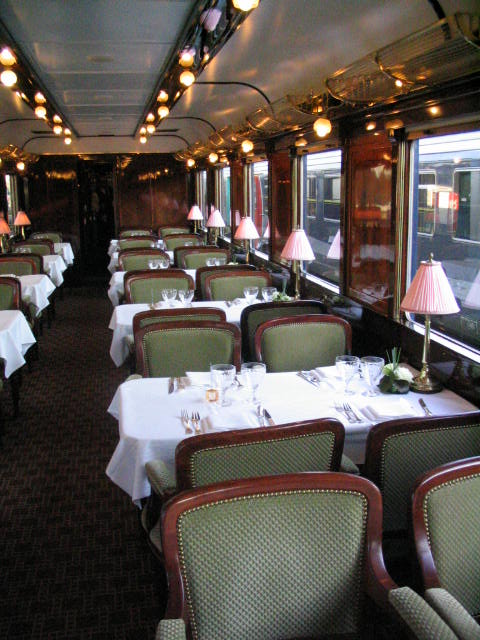
Don't I wish VIA business class was like this.
Dining car, Venice-Simplon Orient Express.
(Simon Pielow, Wikimedia Commons.)
Last month Lorna and I attended Can*Con, in Ottawa (The Nation's Capital!). (And a lovely con it was, too, in a lovely hotel I'm looking forward to returning to.) Ottawa is about a four and a half-hour drive from the east end of Toronto, maybe more like five hours these days, with the extra time being required just to get to the edge of the city. And while I still like a good road-trip, it's no longer my favourite way of getting around.

My favourite way is one of the older ways: I like to take the train.

I think I owe my love of business class on VIA Rail to a couple of friends who took the train to Montreal a while back and described their trip in such glowing terms that I started looking for excuses to take the train anywhere that was more than a couple of hours away. Ottawa fit that bill perfectly.

What I love about taking the train is that it's much more comfortable than a plane, requires much less attention from me than driving, and there are things to look at while I'm sipping my tipple of choice.* The food isn't going to make anyone call up the Michelin Guide, but for my money it's better than anything you can get on a plane outside of first class. And if I want to write I can write (though writing longhand is a bit of a challenge given the way the cars move about as they progress) and if I want to read I can read.

And if I want to just look out the window there's scenery to watch that isn't clouds. In our recent train journeys we have seen foxes and bats and coyotes and the vastness that is Lake Ontario and the marvellous way leaves in this part of Canada can be silver and grey and green and orange, seemingly all at the same time.

Now I'm thinking about multi-day train journeys, in private compartments. Which reminds me of the guy I used to work with at CBC Radio, who would write scripts during cross-Canada rail journeys because confining himself to a train was the only way he could force himself to pay attention to his writing.

*Which is a Hadrian: a Caesar made with gin instead of vodka.

02 December, 2018

Part of This Balanced Breakfast:: The Return of...

One night when I was about eight, I slept over at my girlfriend’s house. (It was the sixties and I was a precocious little nipper.) When we got to her place after school, I was flabbergasted when her mother sat girlfriend and me down in the breakfast nook and placed before each of us a bowl of Alpha-Bits. Cereal? In the afternoon? I was horrified―until I took a mouthful.


I’d never had Alpha-Bits before. My exposure to what I now call kiddyrot cereals had been limited in the extreme. But this… this was a revelation! As good as cereal tasted in the morning, it was a hundred times better at non-breakfast times of the day. And sweet! I decided then and there that I was going to devote my life to a serious study of tooth decay brought on by the over-consumption of sugar.


(Okay, I didn’t, not really. The tooth-decay part is certainly true, though. And my obsession with sugar and breakfast cereal really antedates the story above. It does make a good story, though, doesn’t it?)


Kiddyrot cereals were always in limited supply in our house when I was growing up. For reasons I was never clear on, my mother only bought two kinds of kiddyrot: Honeycomb and Cap’n Crunch. Honeycomb was so boring I often (like Bill Watterson’s Calvin) dumped extra sugar on it in an attempt (unsuccessful, alas) to make it more interesting. Cap’n Crunch was the opposite: to this day it remains one of the most aggressively sugared cereals I’ve ever eaten. Seriously, that shit will cement your teeth together better than Krazy Glue. (Don’t try this at home.)


Fast-forward to the early 1990s. Living in Toronto exposed me to the Buffalo TV market, and to ads for the most bizarre and amazing (and probably disgusting, to most) culinary weaponry I’d ever encountered. At the time I was working for CBC Radio as a movie critic, and I had what I thought at the time was a brilliant Idea: I would review kiddyrot cereals on-air, in the style of a Robert Parker-type wine journalist. I must have been a better salesman in 1992 than I ever was before, or have been since*, because a producer at “Ontario Morning” jumped at it. (I will not identify the producer in question because the statute of limitations has yet to time out.)


Last week, while packing and shifting books and papers in the basement, I came across a couple of the old reviews. I mentioned this to a friend, who begged me to publish them again. So I dug deeper into the trash archives and have transcribed what I found, which I believe is most of what I originally wrote and more than were ever aired (common sense eventually woke up and realized that 6:20 am on a weekday was not really the time for this sort of alleged humour). Over the next weeks I’ll repost the reviews, and might even write some new ones.


Don’t say you weren’t warned.

*Of which my fiction-writing career bears ample witness

30 November, 2018

You Must Remember This (Scene 3, Take 1)

(Over the past couple of days this blog has been discussing the impressive number of drinks poured in  Casablanca, whilst outlining their fates. Few of which involve actually being consumed. If I drank the way these characters do, my liver would be the size of a thumb-drive. Anyway, let's try to wrap up this discussion today.)


Not a bourbon I drink...
(Wikimedia Commons)
Rick's big solitary drinking scene includes, besides the classic "Of all the gin joints..." line, this wonderful exchange:

RICK: Sam?
SAM: Yes, boss?
RICK: If it's December 1941 in Casablanca, what time is it in New York?
SAM: Huh? My watch stopped.
RICK: I bet they're asleep in New York. I bet they're asleep all over America.

There's a scene-within-a-scene here, a flashback montage of Rick and Ilsa's romance in Paris. A lot of champagne is poured in this flashback, and we actually see Rick and Ilsa drink some, at the beginning and at the very end. (As far as I can tell, the one sip Ilsa takes in this sequence is the only drinking the character does in the entire movie. As if to symbolize her attitude toward drink, Ilsa closes the scene in the Cafe Belle Aurore by knocking over a full glass of champagne.)

When the flashback ends, Rick's glass is empty and the bottle has only an inch or so of bourbon in it. When Ilsa intrudes on his misery, Rick pours himself another shot. He downs nearly the whole thing in one belt, too: that's how unhappy he is. Rick hardly touches a drop before this scene; for the rest of the movie, nearly every scene he's in he's holding a drink. (Incidentally, this scene ends with Rick downing another shot of bourbon, a shot we haven't seen him pour.)

The next booze shot (so to speak) takes place next morning at the Blue Parrot, the cafe owned by Signor Ferrari (Sidney Greenstreet). Ferrari offers Rick a drink, to which Rick responds, "I never drink in the morning." Ferrari pours him a drink anyway, from a fresh bottle. Scorning Ferrari's hospitality, Rick walks away without touching the drink. (Ferrari doesn't have much luck with his guests; immediately after Rick leaves he makes, with his own hands, a cup of Arab-style coffee for Ilsa―who sets it aside without even inhaling the aroma. She does thank him for it, though.)

Back at the bar, a couple of extras down drinks while Rick and Louis sip cognac―once again, Louis leaves his drink unfinished. More cognac is poured (and some actually drunk) by Karl and two extras in a comedy-relief bit. Rick finishes the cognac he began drinking with Louis, then sets out to help Bulgarian refugees Jan and Annina Brandel (Helmut Dante, Joy Page) win at roulette; Victor and Ilsa appear at the club and order cognac, apparently tired of all the champagne they didn't drink the previous evening.

Of course they don't drink anything.

After the roulette incident Rick pours himself another cognac (his third of the evening), but only has one sip before Victor drags him away from it. Regardless of the purity of his soul and his politics, this guy sure is a killjoy. At contemporary prices, he and his wife waste several hundred dollars' worth of perfectly good alcohol during the course of the film.

At this point the action starts moving fairly aggressively and the drinks stop flowing. After Rick and Ilsa become lovers again there are a bottle and full glasses of champagne on the table in front of them as they talk, but neither drinks (though Rick does toast Ilsa, one of several times he says "Here's looking at you, kid" to her). The noble Victor does finally stoop to taking an honest swig of elixir, however: after cutting his hand while escaping from the police, he allows Rick to pour some cognac into him. It's only one sip, though, and clearly For Medicinal Purposes Only. (It's no wonder Ilsa prefers Rick to this bloodless shmoo.) It's ironic, I suppose, but Victor is the last person to drink alcohol in the film.

(Tomorrow we'll wrap all this up with some overall thoughts about Casablanca as a movie and as a cultural artifact.)

29 November, 2018

You Must Remember This (Scene 2, Take 1)

(Yesterday this blog began reviewing the history of the various cocktails and other alcoholic drinks pouredthough seldom consumedin the movie Casablanca. Today, both the decadence and the Good Guys proliferate.)

After Louis abandons his expensive cognac untasted, another Bad Person takes the stage: Major Heinrich Strasser (Conrad Veidt) of the Third Reich. Major Strasser shows how decadent he is by ordering an entire bottle of Veuve Cliquot '26 and an entire (large) tin of caviar. Just for himself. What's more, we actually see him eat the caviar (it looks wonderful, and he actually scarfs down big clumps of it with a fork)―though we don't get to see him drink any of the champagne. (There's a continuity gaffe in this scene: Strasser picks up his fork for the first time twice.)

The purest of the Good Guys is also the most profligate of the whole cast in terms of wasting good booze (and bad, for that matter). Victor Laszlo (Paul Henreid) starts off by ordering Cointreau for himself and Ilsa Lund (Ingrid Bergman). No sooner are these delivered than they are sent away, untouched, by Louis, who makes a gift of a bottle of the bar's best champagne. Though we don't actually see the champagne delivered, there are soon three full glasses on Victor's table. Whereupon first Louis and then Victor leave the table without touching a drop.


Champagne cocktail
(Wikipedia)
Victor goes to the bar and orders a champagne cocktail. He doesn't drink any of this either, though he touches the drink to his closed lips twice―at which point Louis reappears and orders him a second champagne cocktail. We don't see what happens to this drink, because the scene shifts to Ilsa and Sam (Dooley Wilson) serenading each other with "As Time Goes By." (A second bottle of champagne has been delivered to the Victor-Ilsa table, but the waiter stops halfway through opening it.)

When Rick and Ilsa finally meet, darned if Louis doesn't appear and order yet another round of drinks―more champagne, as if there isn't enough at the table already. No sooner are the drinks delivered than Louis (remember, he ordered them) announces that it's curfew time, and everybody gets up and leaves.

The big drinking scene―the one that inspired our fantasy portrait―comes next. When the scene opens Rick has already knocked off about half of a bottle of bourbon. He's holding a ten-ounce tumbler that's a third full of straight bourbon, and as the scene progresses we actually see him drink most of the contents of the glass. This scene contains some of my favourite dialogue in the movie. Which I will write more about tomorrow.

28 November, 2018

You Must Remember This (Scene 1, Take 1)

French 75
(Wikimedia Commons)
(This year [2018] marks the 80th anniversary of Everybody Comes to Rick's, the play on which my favourite movie of all time, Casablanca, is based. Over the next few days I'd like to spend some time on a rather unusual exploration of the movie.]

Hanging on a wall in our house is a pen-and-ink sketch: a fantasy portrait of me and Lorna, a wedding present from the late Bob Doyle and the artist, the still-extant George Barr. The sketch is based on a scene in Casablanca: the scene in which Bogart is sitting, drinking and flashing back to his Paris romance with Ingrid Bergman. (This scene contains the classic line "Of all the gin joints in all the towns in all the world, she walks into mine.")

Casablanca is my favourite movie and has remained so for decades; and as I have watched it over and over (and over), one thing has gradually stood out about this movie: for a picture set in a saloon, there is an awful lot of drinking not being done. (With all due respect to Connie Willis's Remake.) During one of my recent rewatchings, I decided to keep track of the fates of the various drinks ordered by the characters in the film.

The first drink we see being served is a gin-and-tonic, delivered by Sasha the Russian bartender to an obviously English customer. As the main raises the glassor, rather, the straw (!)―to his lips, the scene cuts to "Professor" Karl, the waiter played by "Cuddles" Sakall, delivering a tray of drinks to a table. Nobody picks up these drinks.

The first person to actually take a drink is Ugarte (Peter Lorre). Perhaps to indicate that he's a Bad Person (and shortly to come to a Bad End), Ugarte orders a second cognac before he's even taken a sip of his first. One sip is all we see him take, though by the end of his conversation with Rick (Humphrey Bogart), Ugarte's glass is a little over half empty. The scene ends with Ugarte picking up his second drink and just leaving the first one on Rick's table.

The first person to actually finish a drink is Yvonne (Madeleine Lebeau), Rick's sometime girlfriend as the picture begins. She is obviously a Bad Person, because she tosses off an entire cognac in one gulp. When she tries to order a second, Rick cuts her off and sends her home in a taxi. This scene segues into the first of many scenes shared by Rick and Capitaine Louis Renault (Claude Rains), prefect of police.

This scene is a wonderful example of what I'll call bibus interruptus: no fewer than three times before he actually takes a drink, we see Louis lift his glass toward his lips, then stop. Fortunately there is consummation: Louis not only takes a sip, he actually drains his glass. Of course, when he and Rick get up, Louis leaves a nearly full bottle of cognac on the (outdoor) table.

Rick and Louis progress into Rick's office, where Rick pours Louis a fresh cognac from his own private stock (a particularly ugly Art-Moderne cut-glass decanter). Once again, Louis teases us, lifting and lowering his glass without actually drinking. Eventually Louis gets up and leaves the office, abandoning the drink without even sampling it.

Tune in tomorrow, cocktail fanciers, when another Bad Person takes the stage and the decadence grows.