My Writing

Showing posts with label Movies. Show all posts

05 January, 2021

"Who Knew They Were French?"

Okay, the title of the post bears only the most tangential relationship to the subject matter. I just like the quote. And the post is about an SF subject, so there.

One of the ways in which I've sought to occupy my time during this second plague lockdown is by watching video. Mostly movies, it's true (and most of the movies animated, because it's not searing realism I'm wanting right now), but thanks to friends we have also had the opportunity to watch some of "The Mandalorian."

And I was struck by the amazing awfulness of the industrial design of the protagonist's ship. (And I mean this in a good way.)

Razor Crest image
Image ganked from Wookipedia, the Star Wars wiki
I'm sure plenty has been written about the role industrial design plays in SF storytelling, but one thing about this series that impresses me (at least a little) is the way design choices don't always reflect what I might call contemporary "good" taste.

The Razor Crest (stupid name, btw) is a strangely impressive example of this. Because the first thing that popped into my mind when I saw this ship was how much it reminded me of this...

14 June, 2020

There's No Movie for This

No guns here: A still from Kurosawa's The Hidden Fortress (image ganked
from somewhere on the web; original owned by Toho Pictures, no doubt)
I had one very specific goal in mind when I set out to plan Sowing Ghosts: I wanted to set the story prior to 1543. That was the year in which the Japanese got their first look at matchlock firearms*.

Over the next decade and change these  hinawajū effected a great change in the way the Japanese fought one another, a change I did not want to see reflected in the story I was telling. The year 1543 also stands as a placeholder for the fifteenth-century contact between Japan and Europe.

And I definitely did not want any Europeans in this story. I've read too many stories supposedly about early modern Japan in which the viewpoint character is European. (Don't get me started about that Tom Cruise movie.) Nor did I want any guns. I'm as fascinated by firearms as many males are, but they had no place in the story I wanted to tell.

17 January, 2020

Why Is This a Thing?

Further to the ongoing monologue about critics and criticism, yesterday's reading brought me this. Why in the world is this sort of stunt considered necessary?

Okay, that was a rhetorical question. I know perfectly well why it's being done. And knowing this makes me all the more happy I don't have to review movies anymore. Or, in fact, to watch them at all if I don't feel like it.

05 January, 2020

Familiarity's Discontents

(Being the latest in an apparently ongoing discourse on criticism and critics.)

A few weeks ago I was talking movies with my friend Do-Ming and the discussion turned to the critical responses to Frozen 2. I haven't seen the movie myself, but I've noticed a sufficient number of reviews to lead me to mention to Do-Ming that the critics hadn't been as kindly disposed to the sequel as they'd been to the first.

Do-Ming mentioned that he'd been on the aggregator site Rotten Tomatoes* and had noticed that the critics' average was some 20 points lower than the public's average (I think it was something like 77% good for the critics, 97% for the public). What accounted for the difference, he asked. "Are critics really that picky?" One friend (RIP) argued that in fact critics were jerks who wanted non-critics to feel inferior; as I was working as a critic at the time she made this accusation I was somewhat hurt. So I prefer Do-Ming's implication, even though it's not precisely flattering either.

11 November, 2019

Practical Criticism: Making It Work For You

[Now I've got the video for that Doug and the Slugs song, "Making It Work," running through my head...]

A while back I wrote a piece about criticism, attempting to answer the question Is there still a place for this? (My answer was Yes, of course.) At that time I suggested I might have some more to say, and here it is. This is a suggestion for how you can make practical criticism work for you—which is, after all, the point of practical criticism.

I want to start by telling a story. I'll try to keep it short.

05 November, 2019

Astaire Therapy

Fred Astaire and Leroy Daniels in MGM's The Band Wagon
(1953). Image ganked from IMDB and I'm claiming Fair Use.
Been feeling a bit depressed, lately, for reasons there's no point in going into. After several days of this with no improvement in sight, I decided last night that what I needed was a solid dose of Astaire Therapy.

There are few instances of the Dismals, in my experience, that can resist the onslaught of a Fred Astaire dance routine. Sometimes all I need is a little something from The Gay Divorcee or Top Hat, but if things are looking especially grim I pull out the big guns: the opening ten minutes or so of my favourite musical film, bar none, The Band Wagon.

The first song, "By Myself," has always been a sentimental favourite, and I like having it kick off the movie (which is about a fictional Hollywood singing-dancing star bearing a strong resemblance to Astaire, trying to rebuild his career after flaming out in LA). But it's the second number in the film that never fails to cheer me up. (Which is what it's supposed to do, of course.)

The number takes place in a penny arcade that has taken over the space formerly devoted to a Broadway theatre. Fred's more than a little bummed out over what has happened to 42nd Street, but when he encounters a shoeshine man in the middle of the arcade he launches into a dance routine built around the song "Shine on Your Shoes" and the movie launches into the stratosphere of uplifting movie magic*.

What makes this number work so well is Astaire's dance partner. Leroy Daniels was in fact a shoeshine man in downtown LA who had made a name for himself by incorporating a lot of syncopation into his work. He was well enough known to have inspired a minor hit record a few years earlier, and when he was suggested to Astaire the latter, knowing a good thing when he heard about it, said let's do this.

I'm not going to say anything more about the routine, just urge you to watch it for yourself. There's a video embedded in an article about Leroy Daniels on the site Reel Rundown. Go there, and get happy.

*For me, anyway. As always, Your Mileage May Vary

12 September, 2019

A Possible Hiatus

Image from Wikimedia Commons, of course
I've recently undergone retinal surgery, and my recovery from this appears set to take rather longer than I had anticipated. There are no causes for concern, I just hadn't done enough research into the post-operative conditions with which I am having to deal.

The most aggravating of these is the presence of a bubble of air in my left eye, which is behaving precisely the way the bubble in a carpenter's spirit level does... right down to the wobbling whenever the frame around it (i.e. my head) moves. The consequence of this bubble's behaviour is such that typing sets off a riot of jiggling movement in the affected eye. And this movement, after not very many minutes at all, induces a sort of motion-sickness. Nausea is not remotely conducive to creativity.

So I'm not currently able to write: this note is, in fact, the largest number of words I've been able to type in nearly a week. The Bonny Blue Flag posts that have been appearing this week were formatted and scheduled a week ago; when chapter two concludes I won't have any more material available for publishing. Let's hope that by the middle of the month I'm feeling better able to manage a keyboard.

In the meantime, I can read and watch movies without too much difficulty. So I've been entertaining myself by revisiting Kurosawa (Yojimbo, Sanjuro) and by doing something I'd always meant to but somehow never got around to: reading adventure novels from the nineteenth century. I started with Dumas's The Count of Monte Cristo (I read the abridged version, which is 530 pages; the unabridged translation is something like 1,400 pages long and I'm not that desperate for entertainment), then went on to The Three Musketeers (Dumas was clearly paid by the word).

From Dumas I went forward fifty years to Anthony Hope's The Prisoner of Zenda. This novel was spoiled for me, somewhat, because decades ago I read George MacDonald Fraser's Royal Flash, which rips off retells the story so completely the only new thing about the book, for me, was Hope's writing style. About which the less said the better.

Anyway, I am within the possible limits of recovery enjoying myself, and hope to resume posting on a more regular basis fairly quickly. Don't be dismayed, though, if I have to take a week off.

Stay tuned to this channel.

13 May, 2019

Credit After the Fact

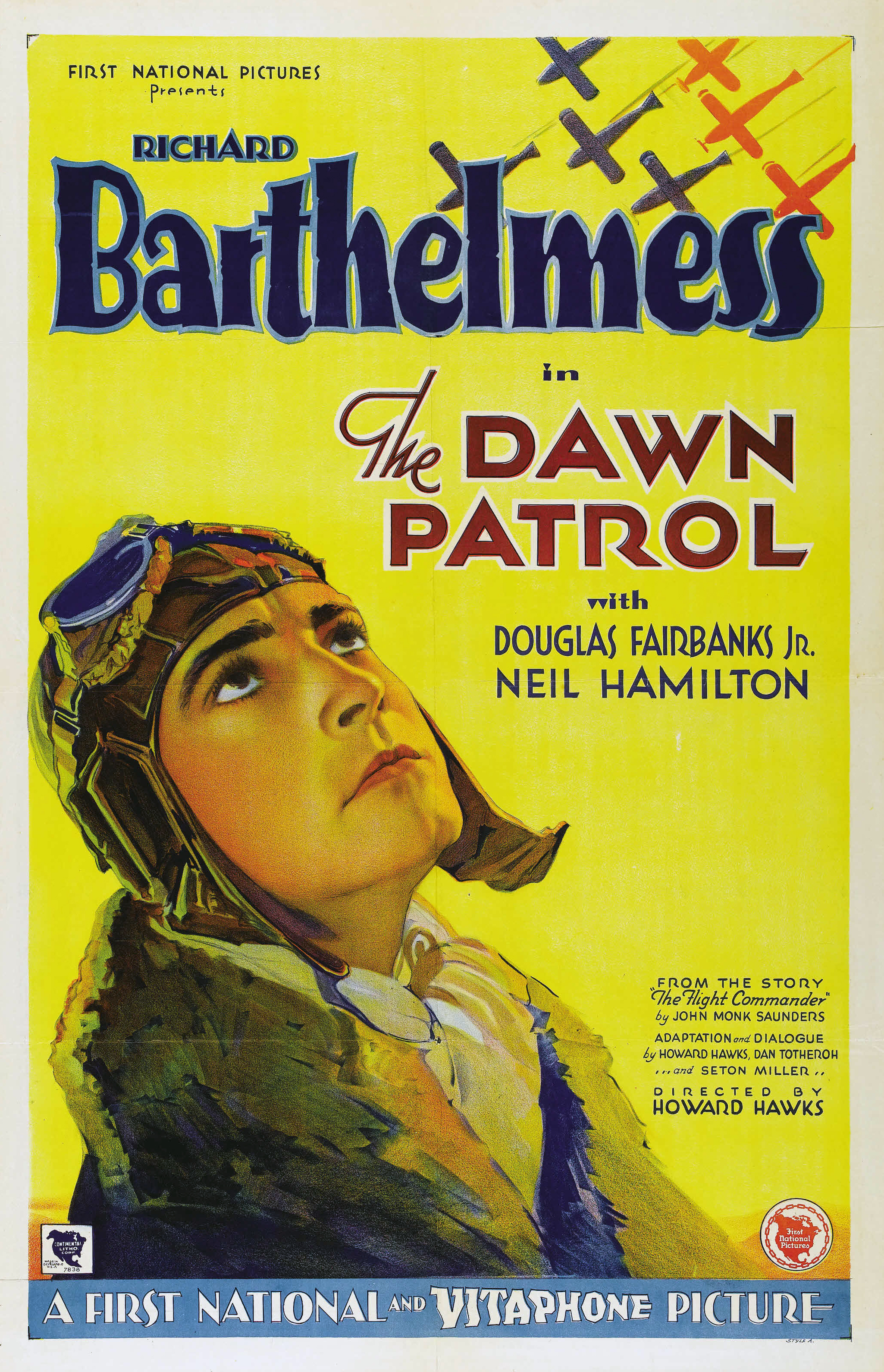
When Warner's remake of The Dawn Patrol premiered on Christmas Eve, 1938, the closing credits featured one of the more unusual acknowledgements in movie history. I noticed this myself only recently, when I re-watched both the 1930 (Howard Hawks) and 1938 (Edmund Goulding) versions* of the movie, and I saw a name I wasn't expecting to see.

06 May, 2019

A Musical Truth: "Singin' in the Rain" as Documentary

Low-res image from Wikipedia.
Trademark owned by Turner
Entertainment; I'm claiming a
fair-use exemption.
Many people regard MGM's 1952 Singin' In the Rain as the best musical ever made. (It's not my favourite, but that's beside the point.) What I like about the movie is the way it manages to tell a fairly accurate story of what it was like to work in Hollywood during the often chaotic transition from silent to sound movie-making.

The history lesson begins at the party hosted by studio head R. F. Simpson (Millard Mitchell) celebrating the premiere of his latest picture, The Royal Rascal (the clips we see are very reminiscent of the 1920s work of Douglas Fairbanks): Simpson shows his guests a demo reel of a "talking picture" system, presented by an unnamed gent played by vaudevillian Julius Tannen.* This sort of demonstration happened a fair amount in the early and mid-'20s—and in fact the first synchronized-sound feature film appeared in 1926, before The Jazz Singer, which is referenced at the end of this scene.

A few scenes later, production of a new picture is abruptly shut down because  the Jazz Singer is a huge hit and Simpson has decided to convert his studio for sound production. This change happens off-screen, which is probably the only way it could have been done.

05 May, 2019

Movie Stunt Pilots of the 1920s and 1930s

Image from Wikimedia Commons
These days, flying sequences in movies are mostly done with computers, though there may be some actual flying involved before the CGI takes over. (For a solid example of how not to do this, see the execrable 2006 Flyboys.) During Hollywood's golden age, however, what you saw on the screen was real airplanes being flown (and often crashed) by real pilots.

It's the world of these pilots that forms the backdrop of the next novel serialized from the Herridge Lake Public Library: High Risk. The serialization begins tomorrow (all things being equal) but I wanted to post a little something about stunt flying in order to provide some information to readers who might not be as obsessed as yours truly with, say, the differences between the two different versions of The Dawn Patrol. (You did know there were two different movies, didn't you?)

Motion picture stunt flying in some senses predates Hollywood itself: dummy aircraft on prop stands, or real aircraft suspended from wires over moving scenery, were used to simulate flying scenes as early as 1912; the earliest films of flying known date from 1905, when the movie capital of the U.S. was Long Island.

06 January, 2019

Somebody Notify Connie Willis

The protagonist of Connie Willis's novel Remake has a depressing sort of job: he uses computers to remove incidents of alcohol and tobacco consumption from classic Hollywood movies, in order to make them socially acceptable for broadcast on television. At the time the book was written (1995) this was a science-fictionally amusing idea.

This afternoon I was channel-surfing and came across a broadcast of Wonder Boys, the 2000 film of the Michael Chabon novel and a movie I liked even if nobody else did. The scene that was playing had a depressed Michael Douglas sitting on the ground with a lit cigarette.

And every time he drew the smoke up to his mouth, the screen blurred around it.

I don't like this movie, Mr. DeMille.

18 December, 2018

They Shall Not Grow Old

Image from 1418 Now media gallery 
My first thought as They Shall Not Grow Old began running last night (it's showing again in North American cinemas on 27 December) was, I have been duped. First, I’d paid 3D prices for a movie that was manifestly NOT in 3D (when I put on the glasses the image jittered about as if it were actual film and the sprockets had shrunk). Second, the footage was old and unrestored, and for the first quarter-hour or so what I was watching was just a bog-standard documentary about first world war recruitment and training.

Then the film shifted to France. And the images filled the screen and shifted to Right Now.

The raves in the media do not do justice to the movie nor to what Jackson’s team did with it. The effect of the speed-corrected, colourized, audio-enabled footage on me was enormous, and I believe the impact on others in the audience was nearly as great. Imagine, then, the impact when we were shown enhanced, colourized photos of the dead.

I have watched a lot of documentary footage concerning the First World War, and many of these images I had never seen before. In some cases this was because of censorship―or self-censorship, on the part of producers or directors―but in others it was simply that the film had deteriorated to the point where nobody was prepared to try to make it watchable.

Nobody but Peter Jackson, that is.

I hope this film is released for home viewing. And I really hope Jackson uses some of the footage from the Imperial War Museum to make a documentary about the Royal Flying Corps.

As marvellous as the movie was, I was equally as interested in the brief How We Did It documentary that followed the closing credits. I am now convinced that Peter Jackson is what I would be if I lived in New Zealand and had a shit-ton of money. The man flew his colourization team to New Zealand from the US so that they could examine the 1914-18 uniforms―in Jackson’s personal collection. Which also includes artillery pieces, shoulder arms, (presumably) machine guns, and flying replica aircraft from the period.

I strongly advise anyone with even a shred of interest in the subject to see this film.

01 December, 2018

You Must Remember This (Scene 4, Take 187)

(This week Quipu has been waxing nostalgicand alcoholic―over the best movie ever made: Casablanca.)

When you see a movie as many times as I've seen Casablanca, it's impossible to ignore its vices. There are occasional bits of leaden dialogue, and there are some outrageously silly gaffes or outright inventions on the part of the writers (for example, Vichy France had no such thing as a Letter of Transit; Victor and Ilsa arrive in and leave Casablanca without luggage―we don't see any in their hotel room, either―yet Ilsa has a new outfit in just about every scene she's in, and Victor―who has just escaped from a concentration camp in Central Europe in November―is tanned, well-built and wearing a crisp summer-weight suit; in reality the Germans had no official presence in Casablanca). in addition, the film makes no reference whatever to the Arab inhabitants of the city or of Morocco.

But these flaws are minor. To me, Casablanca is virtually a perfect lesson in how to create a romantic story. It is as cynical on the surface, and sentimental underneath, as Rick Blaine could ever be. It's an entrancing combination of adventure, romance, wit and humour. It may well take place in a Casablanca that never was (outside of a back lot and sound stage, that is) but it is the essence of high-romance storytelling. To may way of thinking, nobody has ever done it better. Here's looking at you, kid.

As a prosaic aside, it's interesting to note that the wonder that is Casablanca could probably never have come about at any place or time but the Hollywood of the '30s and '40s. The tremendous layered effect of romance, idealism, cynicism and humour was the result of a synthesis. No one writer produced this wonderful story and marvellous dialogue: in fact, counting the writers of the original play, the film was the product of at least nine different writers.

At the beginning of this series I mentioned the stage play, Everybody Comes to Rick's, written in 1938. The first two writers, then, were playwrights Murray Burnett (a high-school teacher) and Joan Alison. In the stage play, the Rick character is a married lawyer and has an affair with the Ilsa character (who is American in the play), whereupon the man becomes so disgusted with the woman's duplicity that he abandons his family and law practice to run a saloon in Casablanca. The central plot revolves around obtaining exit visas, not for Victor and Ilsa, but for the young Bulgarian refugees Jan and Annina (reduced to minor characters in the movie).

The play was considered unproducible (the Ilsa character's sexual behaviour was too outrageous for the time) and the authors shopped it directly to the Hollywood studios―all of which passed. Only after several rewrites would Warner Bros. take it on. And the rewrites weren't done by Burnett and Alison either. They got paid $20,000 for their play and got sent on their way. Then the name was changed, the story was rearranged.

And no fewer than seven writers had a hand in writing the script. Only three were credited, because of a Screenwriter's Guild rule that only two writers or writing teams could share credit on a picture; the team was the brother tandem of Julius and Philip Epstein, while the solo was Howard Koch. Every one of these people contributed something to the final product; it's inconceivable that Casablanca would have become what it is had a single person written it.

Of course, it's equally inconceivable that the movie would have been as compelling as it is had the pure-minded Victor Laszlo been played by Warner Bros. first choice for the role: Ronald Reagan.

30 November, 2018

You Must Remember This (Scene 3, Take 1)

(Over the past couple of days this blog has been discussing the impressive number of drinks poured in  Casablanca, whilst outlining their fates. Few of which involve actually being consumed. If I drank the way these characters do, my liver would be the size of a thumb-drive. Anyway, let's try to wrap up this discussion today.)


Not a bourbon I drink...
(Wikimedia Commons)
Rick's big solitary drinking scene includes, besides the classic "Of all the gin joints..." line, this wonderful exchange:

RICK: Sam?
SAM: Yes, boss?
RICK: If it's December 1941 in Casablanca, what time is it in New York?
SAM: Huh? My watch stopped.
RICK: I bet they're asleep in New York. I bet they're asleep all over America.

There's a scene-within-a-scene here, a flashback montage of Rick and Ilsa's romance in Paris. A lot of champagne is poured in this flashback, and we actually see Rick and Ilsa drink some, at the beginning and at the very end. (As far as I can tell, the one sip Ilsa takes in this sequence is the only drinking the character does in the entire movie. As if to symbolize her attitude toward drink, Ilsa closes the scene in the Cafe Belle Aurore by knocking over a full glass of champagne.)

When the flashback ends, Rick's glass is empty and the bottle has only an inch or so of bourbon in it. When Ilsa intrudes on his misery, Rick pours himself another shot. He downs nearly the whole thing in one belt, too: that's how unhappy he is. Rick hardly touches a drop before this scene; for the rest of the movie, nearly every scene he's in he's holding a drink. (Incidentally, this scene ends with Rick downing another shot of bourbon, a shot we haven't seen him pour.)

The next booze shot (so to speak) takes place next morning at the Blue Parrot, the cafe owned by Signor Ferrari (Sidney Greenstreet). Ferrari offers Rick a drink, to which Rick responds, "I never drink in the morning." Ferrari pours him a drink anyway, from a fresh bottle. Scorning Ferrari's hospitality, Rick walks away without touching the drink. (Ferrari doesn't have much luck with his guests; immediately after Rick leaves he makes, with his own hands, a cup of Arab-style coffee for Ilsa―who sets it aside without even inhaling the aroma. She does thank him for it, though.)

Back at the bar, a couple of extras down drinks while Rick and Louis sip cognac―once again, Louis leaves his drink unfinished. More cognac is poured (and some actually drunk) by Karl and two extras in a comedy-relief bit. Rick finishes the cognac he began drinking with Louis, then sets out to help Bulgarian refugees Jan and Annina Brandel (Helmut Dante, Joy Page) win at roulette; Victor and Ilsa appear at the club and order cognac, apparently tired of all the champagne they didn't drink the previous evening.

Of course they don't drink anything.

After the roulette incident Rick pours himself another cognac (his third of the evening), but only has one sip before Victor drags him away from it. Regardless of the purity of his soul and his politics, this guy sure is a killjoy. At contemporary prices, he and his wife waste several hundred dollars' worth of perfectly good alcohol during the course of the film.

At this point the action starts moving fairly aggressively and the drinks stop flowing. After Rick and Ilsa become lovers again there are a bottle and full glasses of champagne on the table in front of them as they talk, but neither drinks (though Rick does toast Ilsa, one of several times he says "Here's looking at you, kid" to her). The noble Victor does finally stoop to taking an honest swig of elixir, however: after cutting his hand while escaping from the police, he allows Rick to pour some cognac into him. It's only one sip, though, and clearly For Medicinal Purposes Only. (It's no wonder Ilsa prefers Rick to this bloodless shmoo.) It's ironic, I suppose, but Victor is the last person to drink alcohol in the film.

(Tomorrow we'll wrap all this up with some overall thoughts about Casablanca as a movie and as a cultural artifact.)

29 November, 2018

You Must Remember This (Scene 2, Take 1)

(Yesterday this blog began reviewing the history of the various cocktails and other alcoholic drinks pouredthough seldom consumedin the movie Casablanca. Today, both the decadence and the Good Guys proliferate.)

After Louis abandons his expensive cognac untasted, another Bad Person takes the stage: Major Heinrich Strasser (Conrad Veidt) of the Third Reich. Major Strasser shows how decadent he is by ordering an entire bottle of Veuve Cliquot '26 and an entire (large) tin of caviar. Just for himself. What's more, we actually see him eat the caviar (it looks wonderful, and he actually scarfs down big clumps of it with a fork)―though we don't get to see him drink any of the champagne. (There's a continuity gaffe in this scene: Strasser picks up his fork for the first time twice.)

The purest of the Good Guys is also the most profligate of the whole cast in terms of wasting good booze (and bad, for that matter). Victor Laszlo (Paul Henreid) starts off by ordering Cointreau for himself and Ilsa Lund (Ingrid Bergman). No sooner are these delivered than they are sent away, untouched, by Louis, who makes a gift of a bottle of the bar's best champagne. Though we don't actually see the champagne delivered, there are soon three full glasses on Victor's table. Whereupon first Louis and then Victor leave the table without touching a drop.


Champagne cocktail
(Wikipedia)
Victor goes to the bar and orders a champagne cocktail. He doesn't drink any of this either, though he touches the drink to his closed lips twice―at which point Louis reappears and orders him a second champagne cocktail. We don't see what happens to this drink, because the scene shifts to Ilsa and Sam (Dooley Wilson) serenading each other with "As Time Goes By." (A second bottle of champagne has been delivered to the Victor-Ilsa table, but the waiter stops halfway through opening it.)

When Rick and Ilsa finally meet, darned if Louis doesn't appear and order yet another round of drinks―more champagne, as if there isn't enough at the table already. No sooner are the drinks delivered than Louis (remember, he ordered them) announces that it's curfew time, and everybody gets up and leaves.

The big drinking scene―the one that inspired our fantasy portrait―comes next. When the scene opens Rick has already knocked off about half of a bottle of bourbon. He's holding a ten-ounce tumbler that's a third full of straight bourbon, and as the scene progresses we actually see him drink most of the contents of the glass. This scene contains some of my favourite dialogue in the movie. Which I will write more about tomorrow.

28 November, 2018

You Must Remember This (Scene 1, Take 1)

French 75
(Wikimedia Commons)
(This year [2018] marks the 80th anniversary of Everybody Comes to Rick's, the play on which my favourite movie of all time, Casablanca, is based. Over the next few days I'd like to spend some time on a rather unusual exploration of the movie.]

Hanging on a wall in our house is a pen-and-ink sketch: a fantasy portrait of me and Lorna, a wedding present from the late Bob Doyle and the artist, the still-extant George Barr. The sketch is based on a scene in Casablanca: the scene in which Bogart is sitting, drinking and flashing back to his Paris romance with Ingrid Bergman. (This scene contains the classic line "Of all the gin joints in all the towns in all the world, she walks into mine.")

Casablanca is my favourite movie and has remained so for decades; and as I have watched it over and over (and over), one thing has gradually stood out about this movie: for a picture set in a saloon, there is an awful lot of drinking not being done. (With all due respect to Connie Willis's Remake.) During one of my recent rewatchings, I decided to keep track of the fates of the various drinks ordered by the characters in the film.

The first drink we see being served is a gin-and-tonic, delivered by Sasha the Russian bartender to an obviously English customer. As the main raises the glassor, rather, the straw (!)―to his lips, the scene cuts to "Professor" Karl, the waiter played by "Cuddles" Sakall, delivering a tray of drinks to a table. Nobody picks up these drinks.

The first person to actually take a drink is Ugarte (Peter Lorre). Perhaps to indicate that he's a Bad Person (and shortly to come to a Bad End), Ugarte orders a second cognac before he's even taken a sip of his first. One sip is all we see him take, though by the end of his conversation with Rick (Humphrey Bogart), Ugarte's glass is a little over half empty. The scene ends with Ugarte picking up his second drink and just leaving the first one on Rick's table.

The first person to actually finish a drink is Yvonne (Madeleine Lebeau), Rick's sometime girlfriend as the picture begins. She is obviously a Bad Person, because she tosses off an entire cognac in one gulp. When she tries to order a second, Rick cuts her off and sends her home in a taxi. This scene segues into the first of many scenes shared by Rick and Capitaine Louis Renault (Claude Rains), prefect of police.

This scene is a wonderful example of what I'll call bibus interruptus: no fewer than three times before he actually takes a drink, we see Louis lift his glass toward his lips, then stop. Fortunately there is consummation: Louis not only takes a sip, he actually drains his glass. Of course, when he and Rick get up, Louis leaves a nearly full bottle of cognac on the (outdoor) table.

Rick and Louis progress into Rick's office, where Rick pours Louis a fresh cognac from his own private stock (a particularly ugly Art-Moderne cut-glass decanter). Once again, Louis teases us, lifting and lowering his glass without actually drinking. Eventually Louis gets up and leaves the office, abandoning the drink without even sampling it.

Tune in tomorrow, cocktail fanciers, when another Bad Person takes the stage and the decadence grows.