My Writing

Showing posts with label History. Show all posts

05 January, 2021

"Who Knew They Were French?"

Okay, the title of the post bears only the most tangential relationship to the subject matter. I just like the quote. And the post is about an SF subject, so there.

One of the ways in which I've sought to occupy my time during this second plague lockdown is by watching video. Mostly movies, it's true (and most of the movies animated, because it's not searing realism I'm wanting right now), but thanks to friends we have also had the opportunity to watch some of "The Mandalorian."

And I was struck by the amazing awfulness of the industrial design of the protagonist's ship. (And I mean this in a good way.)

Razor Crest image
Image ganked from Wookipedia, the Star Wars wiki
I'm sure plenty has been written about the role industrial design plays in SF storytelling, but one thing about this series that impresses me (at least a little) is the way design choices don't always reflect what I might call contemporary "good" taste.

The Razor Crest (stupid name, btw) is a strangely impressive example of this. Because the first thing that popped into my mind when I saw this ship was how much it reminded me of this...

19 October, 2020

Some Familiar Faces

A tip o' the crash helmet to friend Do-Ming, who pointed me to the following image:

Two of these gents are characters in Dixie's Land or its related short
fiction. The third guy pre-dates all of the stories (but not the timeline)
Image by James Berridge, used without permission; I hope he doesn't mind

The artist in question, James Berridge, has restored and coloured a single portrait shot of every US president who served after the invention of the photographic process but before the development of colour photography. (That's all but the first five and the most recent fourteen, by my estimate.)

There are certainly legitimate objections that could be made to the process of updating old photos in this fashion, but when it's done well it seems to me it can be done while paying real attention to telling details (one that stands out is Coolidge's red hair and freckles, something I not known about before reading Berridge's post on PetaPixel). And in turn this can make it much easier for at least some of us to relate to these gentlemen as individuals and humans with something in common with all of us.

I thought I'd mention it here because of the connection with Dixie's Land. And, really, because since first seeing Jackson's They Shall Not Grow Old, I have been a little bit fascinated with the whole process of restoration/colourization.

22 August, 2020

A Mystery? Not So Much, Maybe

My friend Do-Ming sent me a link this morning to a YouTube video by Adam Savage, one-time Mythbuster and all-round hoopy frood. Savage was interviewing Peter Jackson about one of the latter's many dozens of first-world-war aircraft, and the discovery Jackson (or his staff) made when they removed the fabric from the wings of the (original) SE-5a biplane.

(Note that the images in this post are not those of the machine in question. They're just pix I found in Wikimedia Commons, of museum-display aircraft.)

Royal Aircraft Factory SE-5a
Museum SE-5a (in what looks like a Bessonneau hanger)
Image by Barry Lewis, from Wikimedia Commons

The story thus revealed was interesting... but perhaps not quite as profound a mystery as messieurs Savage and Jackson implied.

There are two reasons for this... and I suppose I ought to summarize the "mystery" first. Briefly, it was that Jackson's team discovered a rolled-up pencil sketch tucked into what I assume was the leading edge of one of the ribs on the lower plane of the wings. The drawing was of an RFC pilot, and the big mystery was the identity of the pilot. Jackson implied that someone had removed the fabric from the wings for repair, and a person or persons unknown had slipped this drawing into the rib before the fabric was restored.

Who was the mystery pilot?

23 July, 2020

Sowing Ghosts Glossary 4

Previous    First

This is the final listing of the Japanese words for objects/titles used in the novel. (Yeah, I rather stretched this out. No, you wouldn't have enjoyed me dumping it all on you at once.)

Tomorrow, if you're still with me, we'll start something new. In the meantime, on to entries for S-Z (well, Y if we're being picky).

22 July, 2020

Sowing Ghosts Glossary 3

Previous    First

Today we list terms in the letter grouping K through R. A reminder: this is a list of Japanese words for some of the objects/titles for which I've used English translations in the novel itself.

As with previous items in the list, if you are interested in pronunciation of these words, this is a decent resource.

21 July, 2020

Sowing Ghosts Glossary 2

Previous    First

Today's list of the Japanese words for certain objects/titles used in Sowing Ghosts covers words beginning D through J. Once again, if you are interested in pronunciation of these words, this is a decent resource.

A Reminder: Japanese grammar does not contain the notion of pluralization for nouns. The same word refers to both a single instance and multiple instances. So in the past Japan had one shōgun; in this story there are two shōgun.

20 July, 2020

Sowing Ghosts Glossary

Previous    First

What follows is a list of Japanese words for some of the objects/titles used in the novel. I realize it's a bit late in the day to be posting this, at least for those of you who've already fought your way through it. But for a list this long, it's more or less traditional it come at the end.

And anyway, unless I figured a Japanese word was common enough in English that most readers would know it (shōgun, katana) I mostly used English translations anyway, to make it easier for readers (and for myself). This is especially true in terms of titles; see bugu bugyō, for instance: "arms master" is just easier for most of us.

This glossary will be posted over the next few days so as to not make something annoyingly long. If you are interested in pronunciation of these words, this is a decent resource. Today's list is a short one, covering words beginning with A through C.

Note: Japanese grammar does not contain the notion of pluralization for nouns. The same word refers to both a single instance and multiple instances. So in the past Japan had one shōgun; in this story there are two shōgun.

05 July, 2020

Decadent Societies, Part 3

From our library; note the Couture
painting, unfortunately black-and-white 

Yesterday I tried to examine the question of American decadence as raised by the late Robert M. Adams in his book Decadent Societies. My conclusion was that, from the perspective of 2020, the USA of the early 1980s was not in fact decadent, and a lot of the symptoms of potential decadence Adams identified turned out not to be all that deadly.

What might be the condition of the USA in mid-2020? Let’s look again at the main symptoms of societal decadence Adams declared:
·       military weakness;
·       losses in major wars;
·       food insecurity (dependence on outside sources beyond the society’s control);
·       technological stagnation;
·       a “grossly oppressive” tax system;
·       acceptance of rising inequality;
·       inability to prevent massive losses through epidemic disease;
·       a complete lack of concern over the increasing proportion of the population with little to no reason to continue to support the society’s existence.

How does the US stack up in 2020?

14 June, 2020

There's No Movie for This

No guns here: A still from Kurosawa's The Hidden Fortress (image ganked
from somewhere on the web; original owned by Toho Pictures, no doubt)
I had one very specific goal in mind when I set out to plan Sowing Ghosts: I wanted to set the story prior to 1543. That was the year in which the Japanese got their first look at matchlock firearms*.

Over the next decade and change these  hinawajū effected a great change in the way the Japanese fought one another, a change I did not want to see reflected in the story I was telling. The year 1543 also stands as a placeholder for the fifteenth-century contact between Japan and Europe.

And I definitely did not want any Europeans in this story. I've read too many stories supposedly about early modern Japan in which the viewpoint character is European. (Don't get me started about that Tom Cruise movie.) Nor did I want any guns. I'm as fascinated by firearms as many males are, but they had no place in the story I wanted to tell.

18 May, 2020

Fighting With Swords

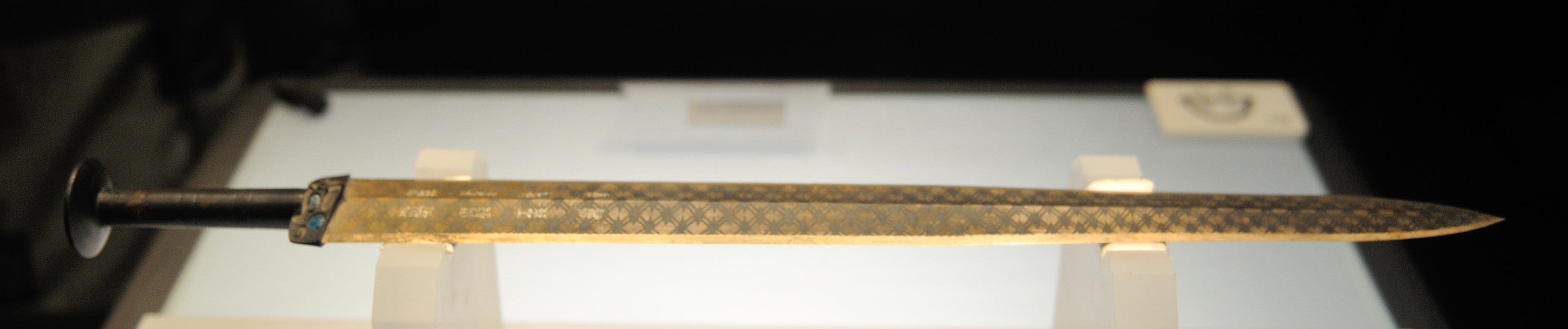
"Sword of Goujian":Bronze sword, China (Spring and Autumn Period, 771-403 BCE).
From Hubei Provincial Museum via Wikimedia Commons

I tried not to spend too much time in Sowing Ghosts going on about Japanese swords and sword-fighting. Honestly, I think too much attention is paid it already, or at least the wrong sort of attention.

(I did a bit more buckling of swashes in A Poisoned Prayer, partly because the plot just demanded it and partly because I wrote the book at least partly under the influences of Dumas the Elder and Richard Lester, the latter of whose film of The Three Musketeers is a thing of joy and wonder. Even so, I tried to be careful about fight scenes.)
Sword of Goujian, again, via Wikimedia

Frankly, most pop-culture depictions of sword-fighting strike me (so to speak) as overly stylized and misleading. Much as I admit to enjoying the interminable fight at the climax of the movie version of Scaramouche (I tried reading the book; Sabatini is impossible), I sort of resent the impression it gives of the way sword-fights worked, even in the eighteenth century when they were as much ritual as earnest combat.

So I was intrigued when Do-Ming sent me a link to a scientific paper reporting on investigations of what bronze-age sword-fighting must have been like. Now, based on what has been reported (more), and on a reading of the paper itself, there likely isn't much similarity between bronze-age swordsmanship and that of feudal Japan.

But there is a single important similarity: under normal conditions, sword-fights were over quickly. None of this charismatic wounding and then fighting back to defeat the foe: if you were wounded in a sword-fight, you invariably lost. Forget eight minutes (which is how long the Scaramouche fight lasts); some sword-fights wouldn't last eight seconds. (This is something Richard Lester and his fight coordinator largely got right in the Musketeers movies.)

For an idea of what I mean, check out the fights Kurosawa put into his movies Yojimbo and Sanjuro, especially the "duel" that ends the latter movie. There's a clip of this on YouTube, which I had probably better preface with a trigger warning; first time I saw it I was, I admit, stunned.

Here is the bronze-age paper itself.

01 March, 2020

Sowing Ghosts: Calendar and Clock


The Japanese calendar and clock were based on the Chinese model as it existed at the time of the Tang Dynasty. What follows is a very brief description, providing only enough information to make the dates and hours used here comprehensible.

YEARS
The Japanese calendar used era names, which were assigned by the imperial household and follow no particular pattern. Era names were changed when the timing was considered auspicious, but also when events were unlucky and a change in luck was desired. The era in which this book is set, Daiei, began in mid-1521 CE; the era name was changed because of a series of inauspicious events (both military and environmental) persuaded the authorities the Eishō era should be ended. The Daiei era itself lasted only seven years (Eishō had lasted some seventeen) before it, too, was brought to an end by various calamities.

29 February, 2020

Sowing Ghosts: Glossary

There's no way around this: a novel set in a different culture and time is going to contain a lot that might confuse the reader.* I have tried to avoid too much use of Japanese in Sowing Ghosts—where a term is more easily rendered in English translation ("Arms Master" for instance, versus Bugu Bugyō) I've done so—but this hasn't always been possible.

So here is a list of some of the terms, names, and titles referenced in the story, with their meanings. I'll put a link to this post at the bottom of each bit of the story as it goes up, over the course of the next few months.

28 February, 2020

Sowing Ghosts: Japan in the Sengoku Jidai Pt. II

During the sengoku jidai, life in Kyoto (the inhabitants seldom called the city anything other than “the capital”), was uncertain for most people, whether they were members of the imperial family, the aristocracy, artisans, merchants or day-labourers. There was no law enforcement because there were no laws. (There were codes of conduct within samurai clans, but in the capital none was being enforced.)

26 February, 2020

Sowing Ghosts: Kyoto in 1528

I had never made a map for any story I wrote, until I came to finish Sowing Ghosts. In this case I came to the conclusion that readers might find it useful to be able to check for themselves the locations of some of the scenes in what follows.

The map I created, shown below, was based on a variety of sources. The primary reference, though, is Mary Elizabeth Barry's The Culture of Civil War in Kyoto. To give readers some idea of the extent of the devastation the capital suffered during the Sengoku Jidai, reflect that on the map below, streets which are shown with a dotted outline are streets along which most of the buildings were burnt in the years prior to 1528... and had never been rebuilt. Most of the destruction, in fact, happened during the Ōnin War, which ended in 1477. That's half a century during which the capital of the country was in large part a ruin.

Note that items in blue on this map are either invented by me or speculative (I could not find any source that would pinpoint the site of the East Market during the period of this story); all other items are as true to the historical record as I can make them.

25 February, 2020

Introducing "Sowing Ghosts"


Yoshino Hiroki doesn’t want to be in Japan’s capital, he wants to be home and killing someone. Anyone. Hiroki has spent nearly two decades running from his aristocratic past, becoming samurai. But “samurai” means “to serve,” so when ordered to investigate a murder he knows he must obey.


Instead of returning to his predictable ― if not safe ― provincial life, Hiroki is drawn deep into the treacherous world of the burned and barricaded capital. He is guided by Katsumi, a tea-shop girl with poetic ambitions, and threatened by enemies and friends, all of them dangerous. Worse, his investigation threatens to revive his dead past, and brings him face-to-face again with the woman who destroyed his old life: His mother.

Could she be the killer? Or is it the adolescent, descendant of a powerful family and seeking his own power? The secretary who wants to wield a sword, not a brush? Hiroki must learn more than spy-craft to deal with what could be domestic violence ― or a political conspiracy that will engulf him and the empire.


Sowing Ghosts is a murder mystery set during the Sengoku Jidai, the age of the country at war. It's not fantasy, nor is it alternate-history.

And before I start serializing the book itself, I'm going to post a few items that I trust will help readers understand the period, and possibly help in keeping track of the characters. The novel itself begins on this site on Monday 2 March.

04 November, 2019

A Great Equalizer?

I was trying to plot out a short story set in the world I've created for the French Intrigues novels (but set sixty or seventy years after A Poisoned Prayer) when I had one of those epiphanies that can totally derail one's creative process.

The story was to be set in Montreal and was inspired by a museum I toured during a (bitterly cold) visit a year ago. The inspiration was a display about the eighteenth-century treaty that ended some two hundred years of war between the First Nations of the St Lawrence basin, war that had drawn in the French and seriously disrupted life for all parties concerned.

It was when I was trying to figure out how magic might affect such a treaty when it suddenly occurred to me to wonder:

If there's magic in the world, is colonialism even possible?

23 September, 2019

Writing Racism

Yesterday I wrote about encounters with racism, for the most part what I'd call incidental, in the nineteenth- and early twentieth-century novels I read while I was waiting for my eye to heal following surgery. One of the novels I read was Kipling's Kim, and I didn't say anything about it in the previous post because it made me think about my writing more than my reading, and yesterday's post was already long enough.

Kipling is usually dismissed, these days, as a racist imperialist (or an imperialist racist, I suppose). I'm not really interested in defending him here—my own opinion probably doesn't count for much anyway, old white and male as I am, and anyway I'm not even remotely interested in trying to defend "The White Man's Burden"; oy fricking vey—but from a writing perspective there's something about Kim that jumped out at me as I read it.

25 August, 2019

Writing Alternate History: Some Advice

New York Public Library
Writing alternate history is definitely an art, and not a science. We should never make the mistake of thinking that our world-building in this regard is defensible on more than a superficial level. And no, I do not think this is a bad thing in and of itself.

I gather there are people out there who like to create alternate histories for their own sake; I also gather that it's accepted in the online alternate history community to write alt-history as a kind of "non-fiction" essay. But I'm a writer of fiction, and the needs of the story come first, well before any pretensions to accuracy in the background world.

Having said this, I will offer one piece of advice I normally try to follow when writing any sort of alternate history:

20 July, 2019

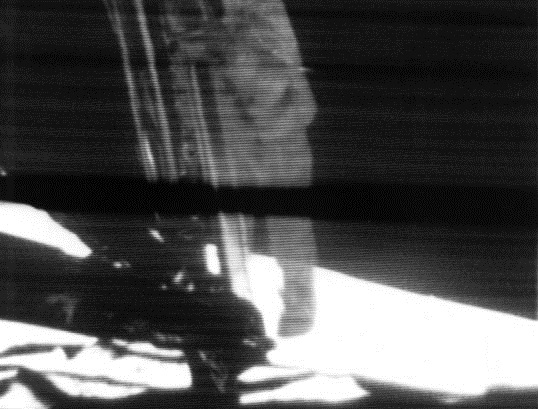
Summer of '69

Neil Armstrong descending from the Lunar Excursion Module on 20 July 1969 (from NASA by way of Wikimedia Commons)
In July of 1969 I was a 14-year-old on vacation in the BC interior with my family, staying on the lakefront acreage of some family friends. I’d been following the US space program slavishly since I could remember*; I had a scrapbook of colour photos from Life magazine, and I had hand-drawn crew patches for all of the Apollo missions to that point. And I was incredibly frustrated at having to be on holiday in the middle of nowhere when the most important event in human history† was happening.
Image from Wikimedia Commons
(creator unidentified)
Our hosts weren’t exactly primitives. They did have a television. But it was a tiny black-and-white (with tubes probably manufactured by De Forest) with the sort of terrible reception you can only really manage in a place surrounded by mountains. So when the Eagle’s hatch finally opened and Armstrong sort of hopped down the ladder, I was practically screaming with frustration, because I could hardly make out what was going on and his first words were all garbled. It was awful in a way that only adolescents would really understand.
It wasn’t until we got back home that I discovered there’d been nothing wrong with our hosts’ TV, and reception had been terrible for everyone. And to this day I can't determine to my satisfaction whether or not Armstrong's first words involved a small step for man, or for a man.
*During the countdown to the launch of the Apollo 10 mission I tried to persuade my parents to allow me to demonstrate my sympathy with the astronauts by living in our tent trailer, inside our garage, for the duration of the flight. What I was going to do about expelling bodily waste does not seem to have occurred to me as an issue to consider.

†That was my opinion. Your mileage may vary.

01 July, 2019

Happy Canada Day... and Memorial Day

Today is a day of celebration across most of Canada, but we should never forget that it's also a day of mourning in Canada's newest province.
Image by William C. Grice, from Wikimedia Commons

The Dominion of Canada was officially proclaimed on 1 July 1867, so today Canada is 152 years old. A bunch of us will celebrate the day at a party being thrown by good friends, and tonight will explode with fireworks.

A different sort of explosion dominated the first day of July in 1916. That was the day the British army launched a major offensive along the Somme River in northern France. One of the regiments participating in that attack was the Newfoundland Regiment, part of the 29th Division.

At dawn on 1 July 1916 the Newfoundland Regiment mustered 1,044 of all ranks, with an actual fighting strength of 929 (the other hundred-odd men were administrative and attached personnel). Of those 929, 780 men were detailed to take part in the second wave of the assault. (It was British policy to leave a portion of a regiment out of the line of battle to form a reserve for rebuilding in case of disaster.)
Newfoundland Regiment cap badge
(Wikimedia Commons)

The assault was a shambles from the very beginning, and the second wave should never have been committed. The German defenders were not killed, wounded or even suppressed by the artillery barrage, and their counter-fire was so effective that huge numbers of the second-wave attackers were killed or wounded while making their way to the British lines. In other words, they never even got the chance to attack.

In under two hours the Newfoundland Regiment was essentially destroyed. Of the 780 who attacked, only 68 answered roll-call on 2 July. For a society as small and close-knit as was Newfoundland in 1914, the result of 1 July 1916 was catastrophic. The day became a day of mourning in 1917, and it remains so today. It should be remembered that Newfoundland did not become a part of Canada until the last day of March, 1949. By that time the tradition of observing 1 July as a day of mourning and memorial was well established.

So today, when raising a glass to the anniversary of Confederation, take a moment to raise a second, silent toast to the memory of the Blue Puttees.
Newfoundland Memorial at Beaumont-Hamel
on the Somme battlefield (author's photo)

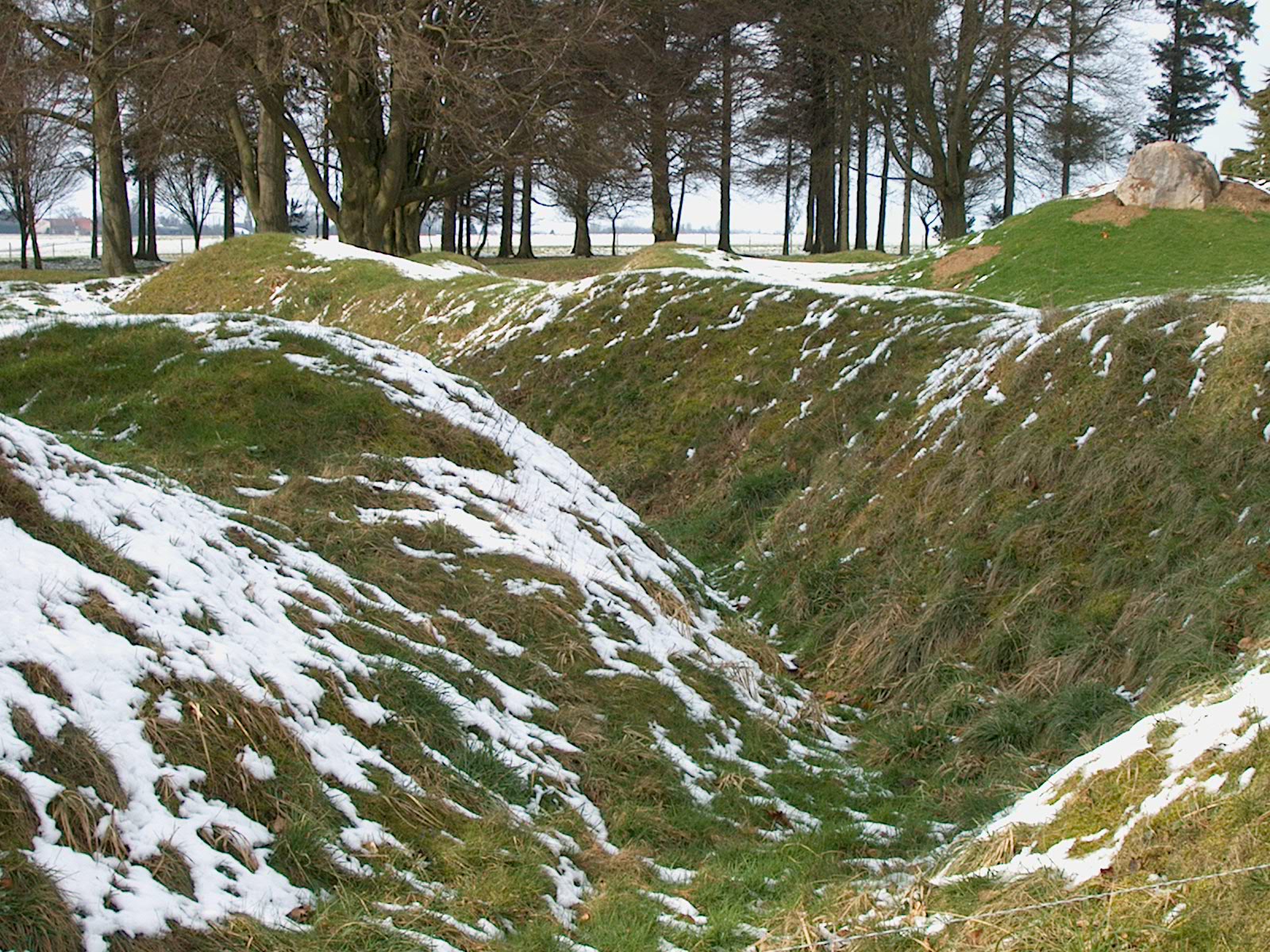
Remains of trenches in Newfoundland Park at Beaumont-
Hamel (author's photo)