My Writing

28 July, 2019

Productivity Update

Having abandoned an SF novel recently, I decided to return to the ethos of alternate history. And I had no trouble whatever working on it, nor did I have any shortage of ideas. It was nice to be able to look forward to the morning writing sessions again.

Flag of the Republic of Texas
(1836-1839) from Wikimedia Commons
And so I'm modestly pleased to announce that I have finished the third and final draft of The Bonny Blue Flag, the sequel to Dixie's Land. There is still a bit of formatting to do, but the writing is complete. Which means I'll be serializing the new(ish) novel* starting in September, shortly after I complete the serialization of High Risk.

I have also written an outline for a third novel set in this particular timeline. There is at least one other project in the queue ahead of that story, though, so it remains at the outline stage for now.

*I wrote the first draft of this novel over twenty years ago, but stopped working on it when Dixie's Land failed to sell.

26 July, 2019

So Long, Science Fiction...

...But You Can Stick Around, Fantasy

I have shut down work on what was my current work-in-progress. After writing 90,000 words of a science fiction novel I realized that my heart just wasn't in it anymore. I was having too much trouble making myself interested in the things that actually made the story SF, and I'm pretty sure the writer's group was picking up on this, because their comments about the character situations were becoming somewhat pointed, where at the beginning they'd been wildly positive.

The problem for me wasn't really the story or characters; I suspect I had enough material in there I could repurpose to make it a fantasy that I'd be happy to keep writing. So the problem is with science fiction. I seem to have lost my taste for it.

High Risk 11.5

Previous    First

[Concluding chapter eleven]

There was a Naval Reserve air base at Long Beach. Casey landed the Bristol there; the Shore Patrol didn’t require much persuasion to refrain from arresting him: they’d seen the comet that was Telford’s Jenny curving south into the marsh. A party from the base was already on its way to the crash site.

Desiree looked terrible. When Casey helped her down from the rear cockpit he felt sorry for her in spite of his anger at her stowing away on the Bristol: her eyes were bloodshot, the skin around them dark and puffy as a result of the buffeting she’d taken from the slipstream. Her hair suggested a badly frayed floor-brush, black strands pointing out to all of the cardinal points of the compass. She shivered as she tottered toward the Shore Patrol car; it might be in the high seventies here on the ground, but aloft it was cool, and the wind had made it downright cold.

Casey stayed with the Bristol until a reserve officer arrived to tell him that he and Desiree would meet the Long Beach police at the crash site; the officer volunteered a car and driver to get them there. Casey accepted the offer with some reluctance: no pilot wanted to have to view the remains of a flamer.

“Neal says we’re not to talk about Lily Cross,” Desiree whispered to him when he sat down beside her. “He’s coming down with some people from the studio; they’ll take care of everything. They’ve called the D.A. already.”

Casey stared at her. “You phoned Neal.”

“Of course I did,” Desiree said, flushing. “I also phoned Hogan to tell him what happened. For what it’s worth, this wasn’t my idea.” She glared at him. “Not that this seems to matter to you. But I can see his point, even if you won’t. Neal has a right to know, Casey. The murder you solved was of a studio employee, remember.”

“If the murder’s solved, why does Neal care whether or not we talk about it to the police? Or is there something going on here that I’m not privy to? Is this what you meant when you said that you were going to look out for your career?”

“That’s unfair, Casey.” Now she didn’t look embarrassed, she looked angry. “My contract with Monarch requires that I leave any involvement with the authorities to the appropriate people at the studio. For that matter, your contract is the same.”

“I don’t think I can be held to a contract that requires me to perjure myself.”

“Oh, don’t be a horse’s ass,” Desiree said. “All that McMahon wants to do is ensure that the press doesn’t take unfair advantage of your solving the crime. And all I want to do is put this behind me.” She closed her eyes. “Though I don’t think I’m ever going to forget what that looked like.”

“Take it from me,” he said, “you never do.” Why are you doing this? he asked himself. Because she deserved to be punished, he thought. Because she had forced her way onto the plane. Because she seemed to care more about preserving the studio’s reputation than she did about Lily Cross’s murder.

“Well, thanks for that bit of support, Casey,” she snapped. “I don’t care what you say or don’t say to the police. But I’m not saying anything, to anyone.”

Next     Prologue    Chapter One    Chapter Two    Chapter Three    Chapter Four    Chapter Five
Chapter Six    Chapter Seven    Chapter Eight    Chapter Nine     Chapter Ten    Chapter Eleven

25 July, 2019

High Risk 11.4

Previous    First

[Continuing chapter eleven]

“Casey.” He struggled to sit up. “What happened?” He recognized Hogan’s voice.

“Telford,” Casey said. He looked around. “Where is he?”

“Took off a couple of minutes ago,” Hogan said. “Was he really trying to steal my Bristol?”

“That’s sure what it looked like to me,” Casey said. He looked around.

Tillman’s body lay, face-down, a few feet away; Hamilton and Desiree were crouched over him. He wasn’t moving, and Casey thought he saw red on the grass. “Sweet Jesus,” he said. “Is he dead?” As he said that, he registered the fact that the Bristol was still here; he was only a few feet from the fuselage of the big two-seater. “He took the Jenny?”

“Yep,” said Mitch. “Tillman’s not dead, but that could change any minute now. You okay, Casey?”

He carefully touched the side of his head. It felt enormous. “What did he hit me with?”

Mitch pointed to a spanner a few feet from where Casey sat. “I’m going to feel that for a few days,” he said. “What happened to Tillman?”

“We don’t know,” Hogan said. “I suppose he tried to help you, and in return got what you got. Casey, why the hell would Telford suddenly decide to steal my Bristol?”

“Mitch didn’t tell you?”

Mitch shook his head. “Didn’t get the chance,” he said. “Soon’s I said Loopy was trying to steal the Bristol, Mr. Hogan here was off like a shot.”

“He told us, though,” Desiree said. “You think Telford killed Lily?”

“Yes,” Casey said. He stood up and grabbed the side of the Bristol’s fuselage. “Mitch, prop me, will you?”

“What the hell are you talking about, Casey?” Hogan grabbed his shoulders, tried to push him away from the plane.

“If he’s flying that Jenny,” Casey said, “I can catch him in the Bristol.”

“And do what? This isn’t the Western Front, Casey. These ships aren’t armed.”

“I can at least find out where he’s going. Did someone call the cops?”

“Straebo’s taking care of that,” Mitch said.

“Good. Look, Hogan, he may be trying to get to Mexico. I’m almost positive that Telford killed Lily. He as much as admitted it to me when he hit me. If we can’t catch him, force him down maybe, he’s going to get away with murder.”

“You just took a solid clocking,” Hogan said. “I’m not sure you should be flying.”

“Don’t forget, Mr. Hogan,” Casey said, “I’ve done this sort of thing lots of times before. If I could fight the Huns hung over—and still drunk, at least once—then I can certainly chase Loopy Telford.” He stepped up onto the Bristol’s lower wing and hauled himself into the cockpit. “Now, somebody prop me. We can’t afford to waste any more time.”

He felt a thump as he adjusted the throttle and flipped the mag switches, but it wasn’t until the Rolls-Royce engine was roaring and the Bristol had started to roll forward that Casey checked over his shoulder—and saw Desiree in the rear cockpit. “What the hell are you doing there?” he yelled. She didn’t answer, just gripped the sides of the cockpit, glaring at him; she wasn’t even wearing goggles. She had ruined his plan: he had counted on bringing Telford back in the empty rear seat. He turned around again to watch where he was going; as the Bristol rolled down the field he screamed every obscenity he knew at her, his anger magnified by the knowledge that she wouldn’t be able to hear a thing over the sound of the engine.

Well, it was too late to throw her out and too damned bad if her weight slowed him down. She had wanted a joy-ride; he would give her one.

A check of the radiator temperature gauge told him that the engine hadn’t fully warmed up yet, but he’d let Hogan worry about any negative consequences. He pushed the throttle all the way forward. The Bristol shook like a wet dog, then leapt forward. The takeoff run was a bit longer than would have been the case with a Tommy, but not by much, and he was off the ground with half the field still ahead of him.

Climbing would waste time; he throttled back a touch and leveled off once he was sure he’d clear the trees. Besides, Telford would be easier to spot against the blue blankness of the sky, something Casey could guarantee by staying low. If he climbed above Telford the Jenny would fade into the patchwork of fields, roads, and buildings below.

He turned south, doing only the most cursory of checks to the north and east. He saw nothing in either direction, and hoped that that meant his guess was correct and Telford was making straight for Mexico. If he’d gone north or east and Casey had missed him, Telford could fly close to two hundred miles before he had to refuel. Los Angeles appeared beneath Casey’s wings.

He saw a speck to the south-east. He steered toward it, watching the air-speed indicator climb to a hundred and twenty. That was more than half again as fast as Telford could manage in the grotesque Jenny; if the speck was indeed Telford, Casey would catch him in under ten minutes. If that’s not Telford, he thought, I won’t know it until I’m practically wing-tip to wing-tip with him. But he didn’t have much choice.

He wondered only briefly if Desiree was feeling any discomfort, or if in some perverse way she was enjoying herself. There was too much else to think about; foremost was the question of what exactly he’d do if he did manage to catch Telford. If the man was drunk or afraid or both he might just give up and land as soon as he saw Casey on his tail. But it was equally possible that he’d ignore him. Do I have the nerve to ram him if that’s what it takes to bring him down?

And if Telford refused to land, what then? The Bristol’s tank was only half-full; that wouldn’t allow Casey to reach San Diego, much less follow Telford over the border. Which meant that wouldn’t even be able to abandon Desiree in Mexico in order to bring Telford back. It was too bad; he’d enjoyed the fantasy for the moment it had lasted.

Whatever was going to happen would have to happen soon: Casey saw in silhouette the huge, ugly comma-shaped rudder that marked Straebo’s Jenny. Opening the throttle a bit, he pitched the Bristol’s nose up to gain some height.

Despite the drop in speed caused by the climb, he still had to throttle back; the Jenny was moving so slowly in comparison with the Bristol that he risked overshooting. Casey nudged the throttle and stick in concert until the Bristol seemed to hover, just above and behind the Jenny. Telford did not look back, and gave no other sign that he was aware of Casey’s presence; the Jenny continued its dogged way toward San Diego, and Tijuana beyond.

I’ll make him see me, Casey thought. Sliding the Bristol down and to port, he opened the throttle just enough to bring him alongside the Jenny, staying just far enough away that if Telford lost control Casey could get out of his way before their machines collided. For a few seconds the two biplanes thundered southward in parallel. Then Telford looked left.

At this distance Casey could make out Telford’s features clearly. Even with the upper part of his face obscured by goggles, the distress was evident; Telford’s mouth drooped so much that for a second Casey thought the man might have started to cry. With his right hand, Casey reached over the side of the Bristol and made elaborate down-pointing gestures. It was a signal any Great War pilot would recognize, but Telford did not acknowledge it. For a while, he simply stared at Casey. Then he pushed his goggles up, exposing his face to the slipstream. He wiped his eyes; he had been crying, after all. He’s given up, Casey thought. Either he doesn’t realize he could still get to Mexico, or he just doesn’t care.

Then the Jenny disappeared behind him.

Cursing, Casey looked over his shoulder; the Jenny’s nose was up. Telford had stalled the Jenny in order to cause him to overshoot.

Casey slammed the throttle forward again, and the Rolls-Royce responded with a roar. Ailerons and rudder to the right, Casey began a wide turn that would bring him back around and behind the Jenny again. As he turned, he continued shoulder-checking, to ensure that Telford wasn’t trying to stunt his way free.

The Jenny was now in a shallow dive, its prop turning slowly. He’s shut off, Casey thought. He’s going to set her down.

It took Casey almost thirty seconds to swing back around and catch up to the Jenny again. Telford, he saw, had one hand outside the cockpit. Was he smashing something against the side of the fuselage? He’s not going to land and then come after me with a broken bottle, is he?

Casey was so caught up in trying to see what it was that Telford was doing with his right hand that the orange-white flash caught him completely by surprise. Only when the Jenny’s fuselage suddenly sported long feathers of flame did Casey realize what he was seeing, what had happened.

He didn’t shut off, Casey thought. He just held down the blip-switch. For nearly a minute, letting petrol fill the cowling and splash along the fuselage, before Telford released the switch, bringing on the spark that turned the Jenny into a biplane torch.

Casey couldn’t bring himself to look away. He held the Bristol in a tight, circling turn, watching as the burning Jenny arced down, describing a shallow curve that ended with another bright orange splash against the green of a marshy field near Long Beach.

Next     Prologue    Chapter One    Chapter Two    Chapter Three    Chapter Four    Chapter Five
Chapter Six    Chapter Seven    Chapter Eight    Chapter Nine     Chapter Ten    Chapter Eleven

24 July, 2019

High Risk 11.3

Previous    First

[Continuing chapter eleven]

"You've got an admirer," Desiree said when she and Cunningham caught up with him. "What a touching scene that was."

"Do you think that Eve was in any real danger?" Cunningham asked.

That's it, Casey thought. "Not for a moment," he said. "She wasn't frightened—though she was trying to pretend to be. You're right about her acting skills," he said to Desiree. "She was angry—I'd almost say furious. When she put her arms around me I found myself flinching and wondered why. Now I think it's because my body suspected she was going to try to throttle me."

23 July, 2019

High Risk 11.2

Previous    First

[Continuing chapter eleven]

With three of them going over every bolt, every wire attachment and every turnbuckle, it took only about a half-hour to pronounce the decrepit Tommy as airworthy as she was ever going to be: the only attachment bolts still loose were the bolts on the lower starboard wing, which Mitch had loosened to make the wing snap off when Casey touched it down. Still nervous, Casey gave Hogan another thumbs-up as the latter climbed back into the DH-4's rear cockpit and gave the camera mounting a test turn. Casey waited until the two-seater was airborne and had completed a circuit over the field before he climbed—carefully—into the Tommy's cockpit.

Before buckling his seat belt he checked to be sure that the heavy cloth strips the studio nurse had wrapped around his chest hadn't slipped. Once sure that his ribs were as safe as anyone could make them, he belted himself in. He was already sweating when Mitch spun the prop to get the Tommy's Gnome started.

22 July, 2019

High Risk 11.1

Previous    First

CHAPTER ELEVEN

"In this scene you're pretending to be the arrogant director, Helms," Straebo said, walking with Casey to where Mitch and the Tommy waited. "So try to suggest cockiness as you move down the field." The director's face was flushed, and he didn't look at Casey while speaking. Casey wondered if Straebo was hung over.
"You think the camera's going to be able to pick up cockiness when all it'll see is his head—and that wearing a helmet and goggles?" Ed Hogan shook his head. "Seems to me you're expecting a bit much."
"What I expect is none of your god-damned business," Straebo snapped. "Do your job, Mr. Hogan. Don't even think of trying to tell me how to do mine."
"Jesus H. Christ," Hogan said as the director stomped off. "What's the matter with him today?"

20 July, 2019

Summer of '69

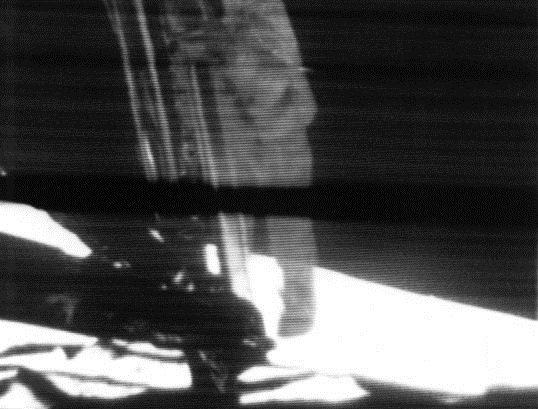
Neil Armstrong descending from the Lunar Excursion Module on 20 July 1969 (from NASA by way of Wikimedia Commons)
In July of 1969 I was a 14-year-old on vacation in the BC interior with my family, staying on the lakefront acreage of some family friends. I’d been following the US space program slavishly since I could remember*; I had a scrapbook of colour photos from Life magazine, and I had hand-drawn crew patches for all of the Apollo missions to that point. And I was incredibly frustrated at having to be on holiday in the middle of nowhere when the most important event in human history† was happening.
Image from Wikimedia Commons
(creator unidentified)
Our hosts weren’t exactly primitives. They did have a television. But it was a tiny black-and-white (with tubes probably manufactured by De Forest) with the sort of terrible reception you can only really manage in a place surrounded by mountains. So when the Eagle’s hatch finally opened and Armstrong sort of hopped down the ladder, I was practically screaming with frustration, because I could hardly make out what was going on and his first words were all garbled. It was awful in a way that only adolescents would really understand.
It wasn’t until we got back home that I discovered there’d been nothing wrong with our hosts’ TV, and reception had been terrible for everyone. And to this day I can't determine to my satisfaction whether or not Armstrong's first words involved a small step for man, or for a man.
*During the countdown to the launch of the Apollo 10 mission I tried to persuade my parents to allow me to demonstrate my sympathy with the astronauts by living in our tent trailer, inside our garage, for the duration of the flight. What I was going to do about expelling bodily waste does not seem to have occurred to me as an issue to consider.

†That was my opinion. Your mileage may vary.