Previous First
[Concluding chapter six]
“I told you that this would work,” Walker told Fontaine and Wheat. The animals had been fed, and the supplies in the wagons topped up to allow another day’s travel. Now the column was ready to move out, and there were still a couple of hours of daylight, plus a long dusk, left before travel would become difficult. According to Pickett, the next sixty to seventy miles of road were dotted with farms suitable to serve as a source of supplies. If God was with them and sped their way, they might not have to replenish their supplies more than once until they reached Bowie county, better than half-way to Washington.

18 October, 2019


17 October, 2019
The Gift of Naming
I've just abandoned my attempt to read a recently published fantasy, a pseudo-Victorian piece*. I'm not complaining about the characters or the plot; to be honest I didn't get far enough into the novel to be able to offer much in the way of an opinion on those scores.
What did for me was the names of the places (and some of the characters). With remarkable consistency these names kicked me out of the story and made me stop and wonder Why that choice? Why not something that fit better?
Lorna talks about something she calls The Gift of Naming. It's that magical talent for the mot juste—okay, the nom juste—that some writers just seem to be born with, and others develop through (I suspect) hard work. I think Sarah Monette has it; Lorna says Ursula Le Guin is the wellspring and Glen Cook an excellent possessor of the talent (she thinks it's more important in fantasy than SF, but I recall being very impressed with what I used to refer to as William Gibson's "brand-name future" as I read his Sprawl novels). And of course names are one of the things most frequently noted about Charles Dickens, though I can say without much fear of contradiction that this is a talent he was still developing when he wrote Pickwick Papers.
*No names. I'm now of the opinion that life's too short to spend time calling out, by name, authors or books I can't recommend. If I mention a book or author by name, it's because I want to recommend it.
16 October, 2019
My Can*Con Schedule

Any readers of this blog who might happen to be attending Can*Con in Ottawa this coming weekend are invited to check out the programming in which I'm participating. I've never attended this convention before but it has an excellent reputation amongst writers I know who have attended in the past. I'm looking forward to the weekend.
I'll be participating in the following:
Criticizing Criticism
Saturday 7pm, Salon D
Is there still a need and a place for the professional critic? I might have a few things to say about this: I worked as a professional critic for three decades.
Tesseracts 22 Reading, Q&A
Sunday 11am, Salon B
I'll be reading a few pages of "If There's a Goal" and then answering a few questions about how I went about researching a story set within living memory.
Hope to see (some of) you there.
Bonny Blue Flag 6.2
Previous First
[Continuing chapter six]
Walker sent the two men over the brow of the hill; he wanted them to be immediately visible to the men in the yard, and to anyone watching from the house. The two talked as they negotiated the downward slope, no doubt discussing tactics. As soon as it was clear that Pickett and James Walker had been seen—Blair and his son dropped what they were doing and rushed to the house, emerging seconds later with shotguns—Walker had the rest of the scouting party walk up to the top of the hill, rifles to the fore. “We’ll just stand here,” he told the men, “and let Mister Blair know that our envoys aren’t alone.”
15 October, 2019
Could I Do a Dickens?
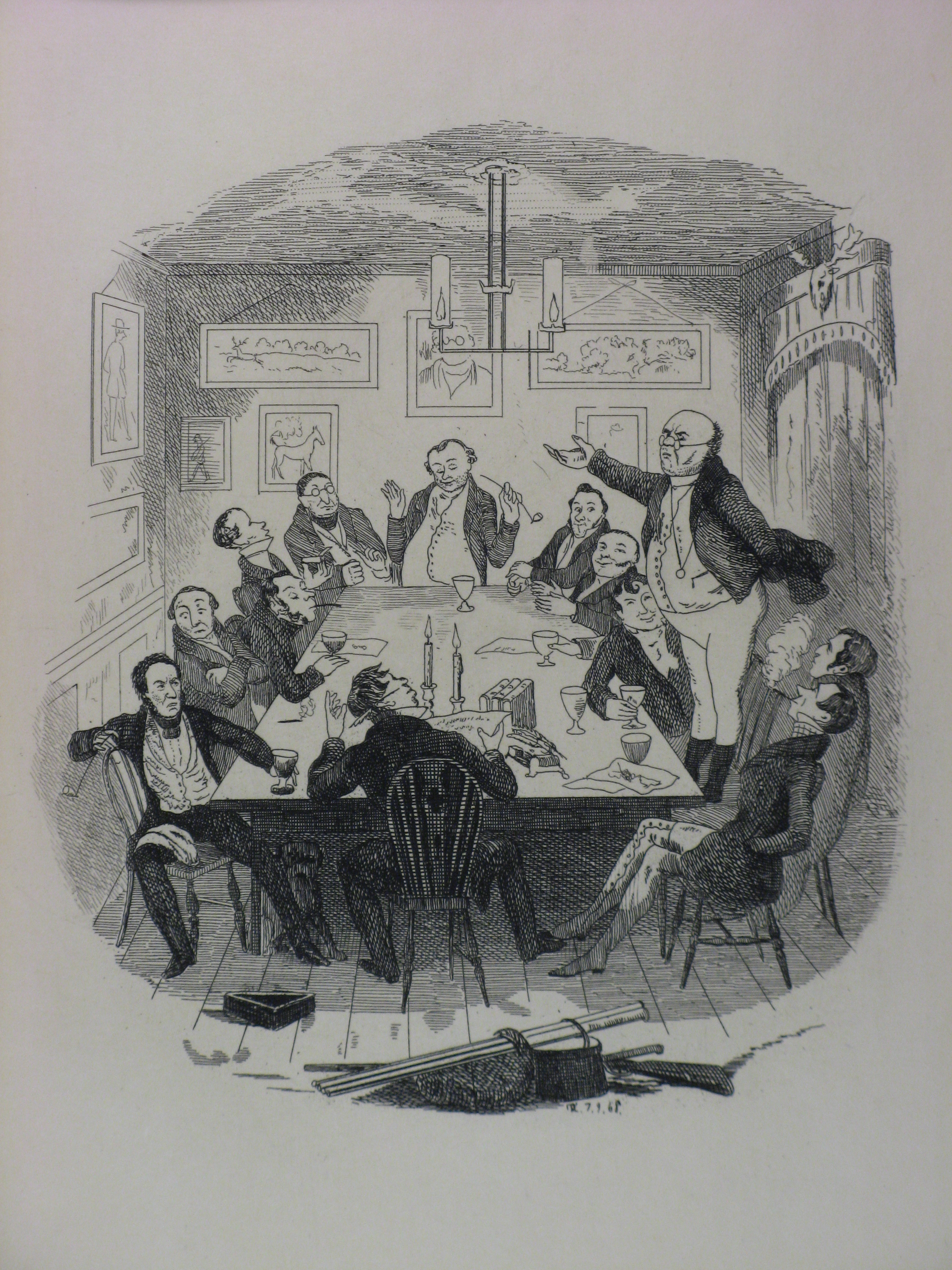 |
| Robert Seymour's first illustration of the Pickwick Club, from the first issue of the novel. Image via Wikimedia Commons. |
(Not that I would ever dare to compare myself with Charles Dickens. For one thing, by the time he was my age, Dickens had been dead for six years.)
I am not sure what I'm learning from this.
Pickwick Papers is sort of notorious for the way it rather dramatically shifted in focus after nine chapters had been written and published. Chapter Ten is when Dickens introduced the character of Sam Weller, who gradually took over the story and eclipsed a lot of the original characters, to say nothing of the original idea behind the story (which was supposed to be a series of anecdotes about comically inept sportsmen). I believe a lot of Dickens's early novels shifted about in this way, not least because the serialization format allowed Dickens to respond to the reactions of his readers.
Compare this with the way most writers work now: draft, draft, and draft again, revising and polishing and not showing the work to more than a handful of people until we think it shiny enough.
Could one serialize a novel in the way Dickens (and, possibly, other nineteenth-century writers) did? Honestly, I don't know if I would have the courage to even try it.
14 October, 2019
Bonny Blue Flag 6.1
Previous First
“Still just two men I can see,” the scout reported. “One’s older—I can see he’s got gray hair. The other’s younger, big and fit.”
“That’d be old man Blair and his boy Tom, probably,” Pickett said. “I could tell better if I got a closer look.” He gazed with undisguised acquisitiveness at Walker’s spyglass. Walker ignored him. After a moment, Pickett turned back to look down the slope at the log house. “Don’t see Stevens anywhere. He’s the hired hand—leastways he was a year ago.”
“Perhaps times have been hard,” Walker said. “Let’s hope not, though. We left nearly two thousand pounds of fodder and twelve wagons back at Mr. Perry’s farm. From the look on his face, I rather doubt I’ll see any of that material again.”
13 MAY 1851
NEAR CARTHAGE, PANOLA COUNTY, REPUBLIC OF TEXAS
“Still just two men I can see,” the scout reported. “One’s older—I can see he’s got gray hair. The other’s younger, big and fit.”
“That’d be old man Blair and his boy Tom, probably,” Pickett said. “I could tell better if I got a closer look.” He gazed with undisguised acquisitiveness at Walker’s spyglass. Walker ignored him. After a moment, Pickett turned back to look down the slope at the log house. “Don’t see Stevens anywhere. He’s the hired hand—leastways he was a year ago.”
“Perhaps times have been hard,” Walker said. “Let’s hope not, though. We left nearly two thousand pounds of fodder and twelve wagons back at Mr. Perry’s farm. From the look on his face, I rather doubt I’ll see any of that material again.”
11 October, 2019
Bonny Blue Flag 5.3
Previous First
[Concluding chapter five]
"What you doing, sir?" Pickett asked.
"Something I should have done, or had done, long before," Walker said, looking up from the paper he'd spread out across the saddle-bag in his lap. "I'm mapping our route through these woods. And I'm going to mark the first of the farms you think will be a good source of supply for us." He fixed his gaze on Pickett. "Panola County extends only about twenty miles west from the border, Mister Pickett. We have to travel another hundred and twenty miles from Carthage before we reach the Brazos Valley and Washington. Will you be able to find us suitable sources of supply for that whole distance?"
09 October, 2019
Bonny Blue Flag 5.2
Previous First
[Continuing chapter five]
Then God spoke to him, and at the same instance the sun emerged from cloud. With a wordless cry of praise Walker leaped to his feet. Of course! Everything has a purpose, he thought. Thank you, Lord, for showing me your Way and your Purpose in this. He stepped down from the porch and walked over to the tree where Fontaine sat, whittling a twig and sipping carefully from a jug.
“I believe, Major, that God has shown me a way of hastening our progress,” he said, struggling to keep his enthusiasm in check. “Tell me: do you think you could move faster if the wagons were less heavily loaded and there were fewer of them? Perhaps if we hitched six mules instead of four to each wagon and used eight instead of twelve wagons per company? How much faster do you think we could move?”
Subscribe to:
Posts (Atom)